Showing posts with label USA. Show all posts

PEOPLE POWER IN THE USA


People Power, 1776, in America.

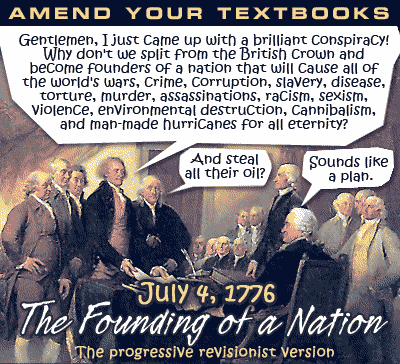
The American Revolution was not 'a good thing'.

The freemasons who took over America were not good people.

"Benjamin Franklin was the Grand Master of the Grand Lodge of Pennsylvania and published the first Masonic book in America. He was a member of Sir Francis Dashwood's Hell Fire Club, along with the Collins family of Satanists.

"Both Franklin and Thomas Jefferson were members of this purely Satanic group who practiced satanic sexual occult rituals." (The Illuminati Bloodlines, Fritz Springmeier)

"Workmen dug up the remains of six children hidden beneath the former London home of Benjamin Franklin, the founding father of American Independence."

United States Presidents and The Illuminati / Masonic Power Structure


Website for this image

Michael Moore said recently that America was "founded on genocide and built on the backs of slaves."

According to Howard Zinn: "the Indians were unhappy about independence from England, because England had set a line - in the Proclamation of 1763 - that said you couldn’t go westward into Indian territory."

"Did blacks benefit from the American Revolution?

"Slavery was there before. Slavery was there after. Not only that, slavery was written into the Constitution."

Untold Truths About the American Revolution | The Progressive

   
Massacre of Indians at Wounded Knee, South Dakota, December 1890

"As a result of the American Revolution, America lost key exports. These included rice, indigo, and tobacco.

"The war produced enormous national debt with millions owed to the French and Dutch governments.

"The fisheries industry was in ruins and agricultural prices decreased to the point where many farmers stood to lose their homes and farms.

"The effects of the Revolution were, for the most part, negative."

Effects of the American Revolution: Post War Conditions in the ...


"New estimates imply that America’s real income per capita dropped by about 22% over the quarter century 1774-1800.

"The Revolutionary War period could have been America’s greatest income slump ever. That fall may have been 28% or even higher in per-capita terms."

America's Revolution: Economic disaster.


Many Americans died in the American revolution.

"The mortality rate among Americans in the Continental army was very high. 


Victim of the war machine.

DECLINE OF THE USA; SYRIA

MacArthur

On 5 February 2012, at Voltaire Network, Thierry Meyssan has an article about the decline of the USA; and about Syria.

www.voltairenet.org/a172632

According to Thierry Meyssan:

1. The USA and Israel have so far failed to achieve their New World Order.

2. Leaders who "choose to serve the United States, like Saddam Hussein, or to negotiate with them, like Muammar el-Qaddafi" see their countries destroyed.

Those who resist the USA, like Bashar al-Assad, and build alliances with Russia and China "will survive."

Iraq
Iraq by The U.S. Army

3. Western leaders and Arab monarchs invented the Syrian revolution.

They "made people believe that the Syrian population had risen against their government."

Satellite channels "shot staged images in a studio to fit their propaganda purposes."

On the ground, "Syria had to face a low intensity war conducted by the Wahhabi Legion supported by NATO."

School meeting
Iraq

4. Russia and China have backed Syria by using their veto.

Iran has announced its intention to fight alongside Syria if required.

iraq
Iraq

5. The United States is "a giant with feet of clay".

The US was defeated in North Korea and Vietnam.

The US has "never controlled the situation in Afghanistan."

The US was "forced to clear out of Iraq for fear of being crushed."

iraq
Iraq

6. The main cause of death of US soldiers is suicide.

One-third of America's serving military personnel suffer from psychiatric disorders.

7. The United States and its allies have been running a vast network of secret prisons and torture centres.

They have kidnapped and tortured more than 80,000 people.

They have created special operations units which boast of political killings in at least 75 countries, according to their own reports.

~

THE BRITISH EMPIRE - MODEL FOR THE US EMPIRE

Child in a British concentration camp in South Africa.


The British Empire is like the American Empire.


The British Empire was involved in:


The drugs trade (Dope inc),


Slavery,


Concentration camps,


False flag terror,


Torture,


And institutionalised racism.


The Jubilee Plot 1887 was the classic false flag operation. British government ministers, led by Prime Minister Lord Salisbury, decided: (1) to use a double-agent Francis Millen to organise a 'plot' to blow up Westminster Abbey, thus killing Queen Victoria and half the British cabinet. (2) to have the plot discovered and revealed during Queen Victoria's golden jubilee. The Jubilee plot employed two Irish-American patsies, Thomas Callan and Michael Harkins.


1. The British Empire was not just the countries painted red on the map.


Professor Linda Colley, of Princeton University (The British Empire ) points out that Argentina, for example, "was substantially run by the British during the 19th century."


And "the US remained economically and culturally dependent on the empire for much of the 19th century."


In Argentina, the British set up railroads and made them "serve British commercial interests" and the British "dominated the banks and investment structure".


In Europe, "naval bases such as Menorca, Gibraltar, Cyprus and Malta allowed the Royal Navy to control the Mediterranean for a very long time."


2. The British Empire was not just 'English'.


Professor John MacKenzie, of Lancaster University, points out that the Irish, Welsh and Scots were important. (The British Empire )


The Irish contributed priests, nuns, doctors and generals to the Empire.


"An obvious Irish contribution was Roman Catholicism and... the Irish... were disproportionately powerful within the British army."


Within the Empire, "many of the universities were founded by Scots on the Scottish model.


"In addition, Scotland was an overproducer of graduates so you had very many Scottish doctors, engineers, foresters, botanists and teachers... There were Scots everywhere.


"Whenever you had mines established around the empire, it was often Welsh or Cornish who inhabited them."


Slaves


3. Britain's empire was a commercial empire, involving slavery.


Dr Sheryllynne Haggerty, of the University of Nottingham, points out that "some merchants were involved in the slave trade, which was integral to the growing of sugar and tobacco in the colonies." (The British Empire )


Various Hubbert Peaks Illustrate Human Nature


4. The American revolution had an impact on the British empire. (The British Empire )


Professor Maya Jasanoff, of Harvard University, points out that when the USA ceased to be part of the empire, "it remained incredibly closely tied to Britain right up to the Civil War, and in some ways even beyond that.


"Economically both countries were dependent on the other and the United States was the main trading partner for Britain.


"It was also the chief destination for British emigrants.


"So when we think of the British empire as a global entity bound together by trade, emigration, and cultural ties, we should remember the ways in which the USA remained involved."


In 1919, at Amritsar in India, Britain's General Edward Dyer ordered his troops to kill unarmed men, women and children. Hundreds were killed. More than 1000 were wounded.


5. India was of prime importance to the British economy. (The British Empire )


Professor Denis Judd, of New York University in London, points out that "Britain was the world’s first superpower because of her flying start in the industrial revolution, her financial and manufacturing domination, her enormous wealth, her stable political institutions, the global supremacy of the Royal Navy and her huge worldwide empire."


"Britain’s trade with India by the start of the 20th century responsible for a fifth of the nation’s overseas commerce."


"There was a large annual balance in Britain's favour.


"British loans to India secured a handsome return in interest, and Indian taxes and revenue paid for the salaries and pensions of the British administration there."


India's railways provided "a good minimum percentage return for British investors."


India's soldiers were "a readily available source of manpower for the exercise of British foreign policy, and at no cost to the British taxpayer."


India provided opium.


In the 1850s, opium revenues accounted for more than 20 per cent of British government revenues in India.


David Sassoon, whose grandson Edward Albert Sassoon, married Aline Caroline de Rothschild, the grand-daughter of Jacob (James) Mayer Rothschild. David Sassoon (1792 - 1864) was the treasurer of Baghdad between 1817 and 1829 and the leader of the Jewish community in Bombay (now Mumbai). The British government gave Sassoon "monopoly rights" to the manufacture of Opium.Sassoon expanded his opium trade into China and Japan. (Hong Kong, the Land Built on Opium )


6. Opium helped bankroll the British empire. (The British Empire )


Dr Julia Lovell, of Birkbeck University of London, points out that the opium trade was "crucial to the running of the British empire."


Opium was grown in India.


The British forced the Chinese to buy the opium.


The 1860 Beijing treaty, after two Opium Wars, forced China to make opium legal.


The profits of the opium were used to buy tea.


The tea was sold in Britain.


The government got its customs duties.


"These duties paid for a large part of the Royal Navy, so opium helped keep the British empire afloat."


Opium also helped fund the British government in India.


The Opium Wars looked like a conspiracy to undermine China.


Sir Stamford Raffles, of the East India Company, brought death and destruction to Java in Indonesia. He sacked and looted cities. He supported slavery. He promoted the trade in Opium.


7. Empires exploit people. (The British Empire )


Professor Huw Bowen, of Swansea University, writes that "one would assume that Britain grew richer and the rest of empire got poorer because the whole point of empires is that they are exploitative."


"To assume that everything the British did was damaging is incorrect.


"British enterprise stimulated a large export trade which might otherwise never have come into existence."


"However, there is no doubt that in the long run specific sectors of the Indian economy did suffer under the yoke of imperialism – the cotton industry was profoundly damaged by cheap imports from Lancashire and Scotland from the 1830s onwards."


William Jardine, together with James Matheson, went into the opium business in China.


8. To some extent the people of Britain and the empire saw themselves as being part of a single British people (The British Empire )


According to Professor Peter Marshall, of King's College London, "a sense of a common British identity was very strong in the later 19th century, particularly among people of British origin in Australia, Canada, New Zealand and English-speaking South Africa."


These countries contributed soldiers in two world wars.


"People in the Caribbean as well as mixed-race people in southern Africa or the elites in India, Pakistan and Sri Lanka could have a strong sense of British values."


Andrea Levy’s novel Small Island refers to Jamaicans who thought of themselves as British.


These Jamaicans "were dismayed by what they regarded as the un-British standards that they encountered in Britain."


In Britain, "attitudes of condescension towards all imperial peoples and downright racism towards non-Europeans were very common."


9. How the end of empire affected Britain.


Dr Sarah Stockwell, of King's College London, points out that "continued attachment to empire through the 1940s and 50s may have had an adverse effect on the British economy.


"It contributed to Britain's initial decision not to join the European Economic Community at its foundation in 1957, while some British businesses also remained focused on traditional markets that were increasingly less important to the country than those in Europe."


Mark Curtis says that in 1971 an official British investigation found that the British army's torture techniques "played an important part in counter-insurgency operations in Palestine, Malaya, Kenya, Cyprus and the British Cameroons (1960-1), Brunei (1963), British Guiana (1964), Aden (1964-7), Borneo/Malaysia (1965-6), the Persian Gulf (1970-1) and in Northern Ireland (1971)".


Leo Amery, former UK Secretary of State for India, could see a similarity between Churchill's attitude to Indians and Hitler's attitude to Jews. (Churchill's Secret War.)


In 1943, millions of people were dying of starvation in Bengal, in India.


The UK prime minister Winston Churchill could easily have stopped the famine by arranging a few shipments of food.


But, but he refused.


He also prevented others from helping.


Winston Churchill described the Indians as "a beastly people with a beastly religion." (Churchill's Secret War.)


He said they "bred like rabbits."


Famine in India - Website for this image


In KENYA, the British used beatings, sexual humiliation, hooding, sleep deprivation, and bombarding with white noise.


32 Whites were killed by the Mau Mau during the five-year state of emergency. More whites died in traffic accidents in the capital city, Nairobi.


Kenyans were forced into concentration camps and routinely tortured. Some 150,000 Africans died as a direct result of the British policy.


There was a "constant stream of reports of brutalities by police, military and home guards", wrote Canon Bewes, a British missionary. "Some of the people had been using castration instruments and two men had died under castration."


Other brutalities included slicing off ears, boring holes in eardrums, flogging people to death, pouring paraffin over suspects and setting them alight and burning eardrums with cigarettes.


A British district officer admitted, "There was outright abuse of power and some of the crimes committed were horrific. One day six Mau Mau suspects were brought into a police station in the neighbouring district to mine. The British police inspector in charge lined them up against a wall and shot them."


A mobile gallows travelled the country. Over 1,000 were hanged, their bodies displayed at crossroads and market places.


British concentration camp in Kenya.


MALAYSIA


The British used terror in Malaya.


This involved aerial bombing, massacres of villagers, dictatorial police measures and the "resettlement" of hundreds of thousands of people.


CYPRUS


During the state of emergency, from 1952 to 1957, the British army used torture.


Cypriot Nicos Koshies:


"They took me to the Special Branch and they started beating me. They took off all my clothes, they tied my hands and feet. They asked somebody to come in. He was taking a stick to put up my bottom, he was putting cloths in water and putting them on my face so I could not breathe, he threw me down and danced on my stomach when he was wearing boots. After 12 days I could not recognise myself."


James Callaghan in the House of Commons:


"On 29 June 1957 an inquest was held into the death of Nicos Georghiou. Dr Clearkin said in evidence that bruises in the head were sufficiently severe to have caused the injuries to the brain, perhaps bumping the head against a hard object."


British concentration camp in South Africa


ADEN/SOUTH YEMEN


In Aden, later known as South Yemen, SAS squads used terror against local villages.


An official investigation found that from 1964 to 1967 detainees at a British interrogation centre were routinely tortured. Their eardrums were burst.


Others were forced to lean against walls with their fingertips for day and subjected to white noise for hours.


British concentration camp in South Africa


BAHRAIN


Former detainees in Bahrain have described being beaten, electrocuted, whipped, tied in excruciating positions for days on end, kept awake, starved and having their toenails torn out.


NORTHERN IRELAND


The Compton official inquiry acknowledged that the army hooded suspects, fed them on just bread and water and blasted them with noise.


An Amnesty International report said, "It is because we regard the deliberate destruction of a man's ability to control his own mind with revulsion that we reserve a special place in our catalogue of moral crimes for techniques of thought control and brainwashing. Any interrogation procedure which has the purpose or effect of causing a malfunction or breakdown of a man's mental processes constitutes as grave an assault on the inherent dignity of the human person as more traditional techniques of physical torture."


A European human rights report found that British army techniques amounted to "inhuman and degrading treatment" causing "at least intense physical and mental suffering".


~~


aangirfan: FEW AMERICANS DIED IN WORLD WAR II


aangirfan: US PLAN TO ATTACK UK

AMERICANS LOVE CHILDREN?

Some Asians like to hug.

'Mommy left us on the sidewalk and drove away'.

On 29 January 2012, the Alisha Adams abandoned her kids, aged 3 and 5, on a street in New York.

Brooklyn mom Dalisha Adams abandoned two kids.

Number of child deaths per day in the USA due to child abuse and neglect

On 29 January 2012, the 13-year-old son of a colonel in the US Airforce was shot dead at his home in the UK.

The colonel is based at the USAF air base in RAF Croughton, in the UK.

US officer's son dies after gunshot

In 1999, an estimated 3,244,000 children in the USA were reported to Child Protective Services

On 28 January 2012, a naked 9-year-old boy was found wandering his North Miami Beach neighborhood.

The boy's bones protruded from his skin, and his eyes bulged from their sockets.

The authorities had been alerted to the child's situation as early as 2007, but had failed to protect him.

Judge: Abused boy looks like concentration camp victim


"Over the past 10 years, more than 20,000 American children are believed to have been killed in their own homes by family members.

"That is nearly four times the number of US soldiers killed in Iraq and Afghanistan.

"The child maltreatment death rate in the US is triple Canada's and 11 times that of Italy."

Why child abuse is so acute in the US

CIA torture of children (MK ULTRA brainwashing)

Children from Texas are nearly twice as likely to die from abuse and neglect as children from Vermont.

Texas is a low tax, low service state.

Vermont is a high-tax, high-service state.

Why child abuse is so acute in the US

Victim of child abuse in the USA

In the USA, "why do husbands beat their wives?

"Why do so many of us support capital punishment?

"Why do we find so much entertainment and enjoyment in films and television programs that depict physical violence?

"The answer is that we are a physically violent society and that child abuse represents merely one aspect of that violence...

"Cultures that gave a great deal of infant physical affection - that is, a lot of touching, holding and carrying - were rated very low in adult physical violence.

"Conversely, the cultures that were rated low on adult physical affection of children were rated very high on adult physical violence."

Article: Child Abuse in America: Slaughter of the Innocents

~~

FAMILY COURTS ARE RUN BY PEDOPHILE RINGS?

RICH AND POOR REGIONS; MISSISSIPPI, OUTER LONDON, CALLAGHAN...

Breakfast in India.

"The differences between countries are often not as great as the disparities within them."

There are rich and poor regions in the USA, in Australia, in Europe, in the UK...

Which is richer - New Hampshire or Mississippi?

Average (median) income 2010

New Hampshire $65,028

Mississippi $35,693

The District of Columbia has a GDP per person five times higher than Mississippi.

In Mississippi only 19% of those aged 25 or over have a degree, compared 48% in the District of Columbia.

Italy - lowest level of regional inequality

"In an analysis of seven countries by The Economist, Italy was found to have the lowest level of regional inequality...

"China's phenomenal growth means that on a purchasing-power-parity basis, the municipality of Shanghai has a higher GDP per head than a quarter of the regions in Britain and Italy..."

Malta - Rich-poor gap grows wider - timesofmalta.com - Times of Malta

Where are the richest and poorest parts of Australia?

The Sydney suburb of Edgecliff and surrounding area is Australia's richest with an average income of more than $186,000 a year.

(http://www.news.com.au/money/money-matters/australias-richest-and-poorest-suburbs-named/story-e6frfmd9-1225845061248#ixzz1jzCopvnK)

In Callaghan, New South Wales, the average income is $27,388.

Zimbabwe has rich and poor areas.

Which is richer - Ireland or the UK?

(The figures below are GDP per capita 2010, in Euros)

Ireland 34,900

Iceland 29,900

United Kingdom 27,400

Iona

Which is richer - Scotland or the majority of regions in the rest of the UK?

(GDP PPP 2008)

Scotland 28,000
East of England 27,200
South West (England) 26,100
East Midlands (England) 25,100
West Midlands (England) 24,800
North West (England) 24,200
Yorkshire & the Humber 24,000
Northern Ireland 22,800
North East (England) 22,200
Wales 21,200

Thailand has rich and poor areas.

How does North East Scotland compare with most areas of England?

North Eastern Scotland 39,300

North Yorkshire 25,900
Greater Manchester 25,700
West Yorkshire 25,600
Herefordshire, Worcestershire Warwickshire 25,300
Outer London 25,300
West Midlands 25,100
Derbyshire & Nottinghamshire 24,000
Dorset & Somerset 24,000
Essex 24,000
Northumberland and Tyne & Wear 23,900
Kent 23,200
Lancashire 22,500
Cumbria 22,300
East Riding; Northern Lincolnshire 22,000
Devon 21,800
Shropshire; Staffordshire 21,800
South Yorkshire 21,500
Lincolnshire 20,500
Merseyside 20,300
Tees Valley & Durham 20,200

Berlin

It is possible to narrow the gap.

"GDP per head in Germany’s five poorest states (all in the east) fell by slightly less during the downturn than in the five richest.

"This continues the dramatic convergence of the past two decades, thanks partly to huge ... funds for infrastructure, Research & Development and education, as well as the transfer of some manufacturing jobs from factories in the western states to the east.

"In 1991, just after unification, Hamburg was five times richer than the poorest eastern region; now it is only 2.3 times richer."

Regional inequality: Internal affairs The Economist

TOP NATION

Elvis Presley had Scottish origins.

Scotland would be the 6th richest country in the world if it had INDEPENDENCE

The revenue from Scotland's oil, over the last several years, amounts to £3.48 trillion.

Over the past 30 years, Scotland has produced more oil than Dubai and Abu Dhabi combined.

Over the past 30 years, Scotland has produced almost as much oil per capita as Saudi Arabia.

Uncle Sam was Scottish.

There is still a lots of oil off the coast of Scotland.

Half the oil is still to come

(SCOTTISH OIL RESERVES EXCEED ESTIMATES / 60% INCREASE IN ESTIMATES OF UNTAPPED OIL .../ Scotland's true oil wealth was hidden to stop independence.)


Each year in Scotland, tourists spend £4.5 billion.

Scotland's whisky exports are worth around £4 billion a year.

Scotland has 8.4% of the UK population, but in 2009-2010 paid 9.4% of the UK tax revenue.

The Scottish government has had budget surpluses, while the London government has been getting ever deeper into debt.


What does the Jewish media say?

According to Melanie Phillips, Jewish journalist and friend of subsidised Israel, "The only way to save the United Kingdom is to stop throwing cash at the Scots."

The Scots, who are a mixture of races, are said to rule the world. (JEWISH SCOTLAND)


So, what have the Scots ever done for us? (The Independent)

Scotland has produced huge numbers of famous thinkers:

Adam Smith author of The Wealth of Nations.

Sir William Paterson who thought up the idea of the Bank of England.

Kirkpatrick Macmillan who invented the bicycle.

Davy Crockett was Scottish

Thomas Telford who designed some of Britain's most famous canals.

Andrew Carnegie, billionaire steel magnate, who built New York's Carnegie Hall.

Glasgow chef Ali Ahmed Aslam who invented chicken tikka masala.

James Clerk Maxwell, a Scot, was one of the world's top scientists. He identified and wrote the equations of the electromagnetic field. That made possible the mobile phone, satellite communications, radio and television.

More famous Scots:

Admiral Thomas Cochrane who was commander of the Chilean navy.

Sir James Simpson who invented chloroform.

James Maxwell who invented colour photography.

Dr Henry Faulds invented fingerprinting.

John Napier invented logarithms.

Dolly the Sheep was invented in Edinburgh.

Life expectancy in some parts of Scotland, such as Calton in Glasgow, is lower than in India. Scotland's wealth is stolen by the rich elite in London.

More famous Scots:

Peter Pan was invented in Scotland by J M Barrie.

Alexander Bain invented the fax machine.

Sir Thomas Lipton invented the World Cup.

Alexander Cummings invented the flush toilet.

George Cleghorn discovered that quinine could cure malaria.

Robert watson-Watt, the inventor of radar, was Scottish.

Scotland invented golf.

Scotland invented gospel singing which led to black gospel music.

More famous Scots:

James Braid was the first, in recent centuries, to experiment with hypnotism.

Alexander Wood invented the hypodermic syringe.

James Watt developed a way of making steam engines efficient, to speed trains along.

Sir David Brewster invented the kaleidoscope.

William Thomson, Lord Kelvin, invented the Kelvin Scale.

King James, of the King James Bible, was Scottish.

Lachlan Rose invented Lime Cordial.

Robert Louis Stevenson and Captain Kidd were Scots.

Alexander Fleming was Scottish.

More famous Scots:

Dick and Mac McDonald who invented McDonald's burgers were of Scots descent.

Robert Watson-Watt developed the magnetron which has led to the microwave.

James Young discovered that by using heat you could distil coal to make paraffin.

Alexander Fleming discovered penicillin.

John Broadwood is credited with developing the piano foot-pedal.

John Boyd Dunlop invented the pneumatic tyre.

James Watt was the first to use a propeller, applied to a steam engine, on board ships.

Robert Watson-Watt invented radar.

Charles Macintosh invented the macintosh.

James Watt was Scottish

More famous Scots:

William Cullen invented the refrigerator.

Elvis's ancestors came from Aberdeenshire.

Dr John Harvey Kellogg, who invented cornflakes, was of Scottish origin.

James Nasmyth invented the power-driven hammer.

William Ged invented the stereotype, a type of printing plate.

John McAdam invented tarmacadam.

Alexander Bell invented the telephone.

Davy Crockett came from Scotland.

Scotsman John Boyd Dunlop invented the inflated rubber tyre.

More famous Scots:

John Logie Baird was the first person to publicly demonstrate a working television system.

Samuel Wilson, America's Uncle Sam, was from Scotland.

John Paul Jones founded America's navy.

Thomas Jefferson was one of 23 American presidents with Scottish or Scots-Irish origins.

Sir James Dewar invented the vacuum flask.

Lord Kelvin, a Scot, played key roles in everything from thermodynamics and electric lighting to transatlantic telecommunication and the age of the Sun.

List of some Scottish Enlightenment thinkers

Robert Adam (1728-1792) architect

James Anderson (1739-1808) agronomist, lawyer, amateur scientist

Joseph Black (1728-1799) physicist and chemist, first to isolate carbon dioxide

Hugh Blair (1718-1800) minister, author

James Boswell (1740-1795) lawyer, author of Life of Johnson

John Logie Baird was Scottish

Thomas Brown (1778–1820), Scottish moral philosopher and philosopher of mind; jointly held the Chair of Moral Philosophy at Edinburgh University with Dugald Stewart

James Burnett Lord Monboddo (1714-1799) philosopher, judge, founder of modern comparative historical linguistics

Robert Burns (1759-1796) poet

Alexander Campbell (1788-1866) founder of the Restoration Movement

George Campbell (1719-1796) philosopher of language, theology, and rhetoric

Sir John Clerk of Eldin (1728-1812) prolific artist, author of An Essay on Naval Tactics; great-uncle of James Clerk Maxwell

William Cullen (1710-1790) early medical researcher and chemist

Adam Ferguson (1723-1816) considered the founder of sociology

James Hall, 4th Baronet (1761-1832) geologist, geophysicist

Henry Home, Lord Kames (1696-1782) philosopher, judge, historian

David Hume (1711-1776) philosopher

Francis Hutcheson (1694-1746) philosopher of metaphysics, logic, and ethics

James Hutton (1726–1797) founder of modern geology

Sir John Leslie (1766-1832) mathematician, physicist, investigator of heat (thermodynamics)

John Millar (1735-1801) philosopher, historian, historiographer

John Playfair (1748-1819) mathematician, author of Illustrations of the Huttonian Theory of the Earth

Alexander Graham Bell was Scottish

Thomas Reid (1710-1796) philosopher, founder of the Scottish School of Common Sense

William Robertson (1721-1793) one of the founders of modern historical research
Sir Walter Scott (1771-1832)

William Smellie (1740-1795) editor of the first edition of Encyclopædia Britannica

Adam Smith (1723-1790) whose The Wealth of Nations was the first modern treatise on economics

Dugald Stewart (1753-1828) moral philosopher

John Walker (naturalist) (17310-1803) Natural History Professor

James Watt (1736-1819) student of James Black; engineer, inventor (Watt steam engine)

Popular Posts

Followers